
India's 29th state is born; Good Morning Telangana
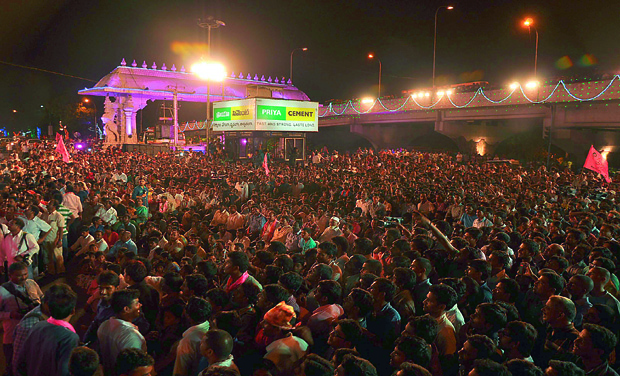
A massive crowd gathers at Tank Bund in the city on Sunday night to celebrate the birth of Telangana state. Slogans and the thunder of fireworks reverberated into the night as people joined in the celebrations to mark the historical day. (Photo: DC)
Hyderabad: Monday sees the end of six decades of struggle for self-rule and the birth of Telangana, the 29th state of the country.
“We achieved Telangana. The long cherished dream of the people, and mine too, has come true. It’s now a new beginning. Like the Telangana movement, there is a need for another movement for reconstruction and development of Telangana state,” said TRS chief K. Chandrasekhar Rao, who will take oath as the first Chief Minister of Telangana on Monday, June 2, the Appointed Date for the formation of Telangana.
Telangana, which comprises 10 districts — Hyderabad, Ranga Reddy, Mahbubnagar, Medak, Karimnagar, Nizamabad, Adilabad, Warangal, Khammam and Nalgonda — will soon have 24 districts if Mr Rao has his way.
By Sunday, Hyderabad had turned into a “Pink City” with TRS flags everywhere. The celebrations, which started from morning, reached a feverish pitch by evening as the darkening sky was lit by dazzling displays of fireworks, and the city was ablaze with lights.
TRS, Congress and other political parties as well as pro-Telangana groups lined up a series of programmes to celebrate the formation of the new state.
The streets were full of dancing youth. Prominent landmarks like the Secretariat, Assembly, Charminar, Secunderabad Railway Station, Kacheguda Railway Station, Tank Bund, and People’s Plaza, besides other parts of the state, were lit up.
Telangana supporters also took out victory rallies and distributed sweets to celebrate the occasion.
Congress leaders took out a rally on Sunday night, hailing their party president Sonia Gandhi for making separate statehood for Telangana a reality.
Andhra Pradesh Governor E S L Narasimhan was sworn in as the Governor of Telangana, the country's 29th state, on Monday.
Andhra Pradesh High Court Chief Justice Kalyan Jyoti Sengupta administered the oath to Narasimhan, who will be the common Governor to Telangana and residuary Andhra Pradesh. Hyderabad will be the joint capital of Telangana and residuary Andhra Pradesh.
Mr Rao will be sworn in by Governor E.S.L. Narasimhan at Raj Bhavan on Monday at 8.15 am. Before taking oath, he will offer floral tributes at the Martyrs Memorial at Gun Park in front of the state Assembly at 7.30 am and later take salute at the ceremonial parade organised by the police at Secunderabad Parade Grounds at 10.40 am.
(Read: K Chandrasekhar Rao has glittering invitee list for
swearing in ceremony)

 C R Gowri Shanker, Political Editor, Deccan Chronicle with TRS president K Chandrasekhar Rao at his Erravalli farm house in happier mood.


KCR in NIMS Hospital, Hyderabad. Left Prof Jayashankar, Nayani Narasimha Reddy and others


2014 Lok Sabha election results:
KCR creates history in Telangana, TDP bounces back in Seemandhra
DC | C R GOWRI SHANKER/CH V M KRISHNA RAO
Published May 17, 2014, 12:22 pm IST
Updated
Apr 1, 2019, 7:41 am IST
KCR set to become CM of India's 29th state, Naidu promises to develop Seemandhra
Published May 17, 2014, 12:22 pm IST
Updated
Apr 1, 2019, 7:41 am IST
KCR set to become CM of India's 29th state, Naidu promises to develop Seemandhra
Telugu Desam Party President N. Chandrababu Naidu displays the victory symbol to supporters and Telangana Rashtra Samiti chief K Chandrasekhar Rao sitting with party members (Photo: PTI/DC)
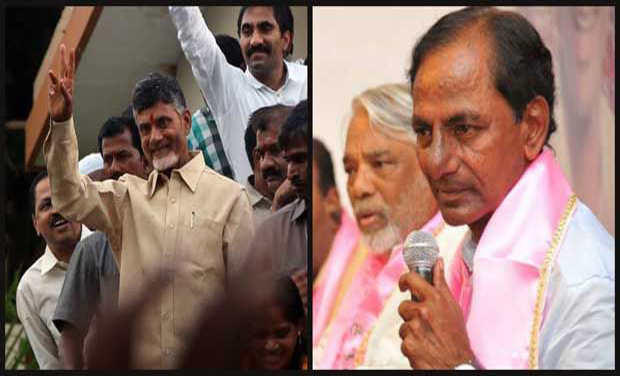
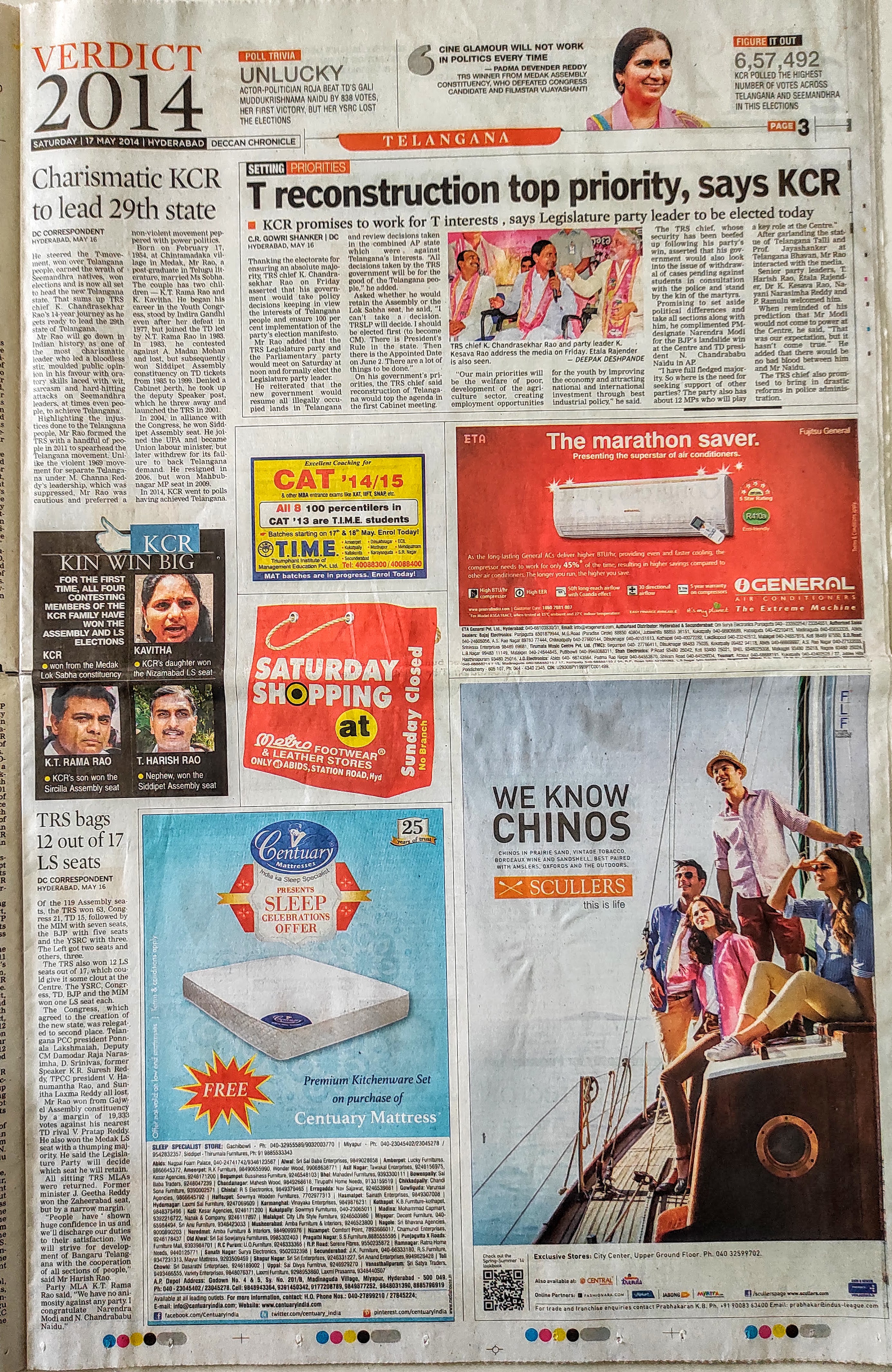
Hyderabad: The TRS led by K Chandrasekhar Rao, swept the Assembly and Lok Sabha elections on Friday and is all set to form the first government in the new state of Telangana.
The party won 63 Assembly and 11 Lok Sabha seats. Mr Rao, who successfully led the 14-year Telangana movement for a separate state and finally achieved it, will be the first Chief Minister of Telangana state after he is formally elected leader of the TRS Legislature Party on Saturday and invited by Governor E S L Narsimhan to form the government.
Party leaders have already made arrangements for the swearing-in of Mr Rao and his Cabinet at the Lal Bahadur Stadium on June 2, the date on which the new state comes into existence officially.
(Read:Telugu Desam, BJP face Cabinet blues in Seemandhra)
Party sources say he is finalising the Cabinet in consultation with senior party leaders.
The TRS, which began from scratch winning 10 seats initially and 26 subsequently, has now got an absolute majority.

Of the 119 Assembly seats, the TRS won 63, Congress 21, TD 15, followed by the MIM with seven seats, the BJP with five seats and the YSRC with three. The Left got two seats and others, three. The TRS also won 12 LS seats out of 17, which could give it some clout at the Centre. The YSRC, Congress, TD, BJP and the MIM won one LS seat each.
The Congress, which agreed to the creation of the new state, was relegated to second place. Telangana PCC president Ponnala Lakshmaiah, Deputy CM Damodar Raja Narasimha, D. Srinivas, former Speaker K R Suresh Reddy, TPCC president V Hanumantha Rao, and Sunitha Laxma Reddy all lost.
Mr Rao won from Gajwel Assembly constituency by a margin of 19,333 votes against his nearest TD rival V. Pratap Reddy. He also won the Medak LS seat with a thumping majority. He said the Legislature Party will decide which seat he will retain.All sitting TRS MLAs were returned. Former minister J. Geetha Reddy won the Zaheerabad seat, but by a narrow margin.“People have shown huge confidence in us and we’ll discharge our duties to their satisfaction. We will strive for development of Bangaru Telangana with the cooperation of all sections of people,” said Mr Harish Rao.
Party MLA K.T. Rama Rao said, “We have no animosity against any party. I congratulate Narendra Modi and N. Chandrababu Naidu.”
Naidu back with a bang in residuary Andhra Pradesh
After a gap of 10 years, Telugu Desam N Chandrababu Naidu returned to power after the party’s impressive performance in the Assembly polls in Seemandhra region.
The party’s victory was thanks to Mr Naidu’s excellent poll management and of course the Modi wave, which helped the TD-BJP combine to secure 106 Assembly seats in the House of 175.
The TD crossed the magic mark of 88 on its own and bagged 102 seats. The brilliant performance of the combine also stretched to the Lok Sabha results with the TD getting 14 and the BJP two.Chief Minister designate Naidu on Friday night declared the win a result of a “silent wave and silent revolution” that had worked in favour of the TD and BJP combine which no one had foreseen. Even the two independents who won Assembly seats are Telugu Desam rebels.
Meanwhile, the YSR Congress led by Y S Jagan Mohan Reddy, which was sure of a win in the fiercely fought polls, has to be content with the role of the ain opposition with 67 Assembly seats.s. On the other hand, Friday saw the Congress’ worst ever performance in Seemandhra region as the party could not register a single victory in the 175 Assembly or the 25 Lok Sabha seats.
All the past and present PCC presidents lost and the Seemandhra voters ensured that several former ministers including Anam Ramnarayana Reddy lost their deposits or came a poor third.The Jai Samaikyandhra Party launched by former chief minister N. Kiran Kumar Reddy also lost miserably with all its candidates barring one losing their deposits.
The people of Seemandhra region not only exercised their wisdom in choosing a stable government in the TD-BJP combine but also gave a clear mandate in its favour and proved the political pundits who had predicted a hung house, wrong.
Except the ruling TD-BJP combine and opposition YSRC, no other party will have representation in the AP Assembly.
It was clear that the voters of Seemandhra held the Congress responsible for bifurcation and punished it with vengeance; at the same time they chose the Modi-Naidu combine to rule them hoping for large-scale development in and around the new capital for the residuary state.
With regard to the 25 Lok Sabha seats, the TD won 15, BJP two and YSRC eight. All Union ministers from the Congress,like Kishore Chandra Deo, M.M. Pallam Raju, Panabaka Lakshmi and Kotla Surya Prakash Reddy lost.
Ms Y.S. Vijayalakshmi, mother of Mr Jagan, lost the Visakhapatnam LS seat to BJP Seemandhra president Kambhampati Haribabu who emerged as a giant killer.


Problem of plenty for K Chandrasekhar Rao
DECCAN CHRONICLE | C.R. GOWRI SHANKER

Telangana Chief Minister K. Chandrasekhar Rao.
Hyderabad: If Chief Minister K. Chandrasekhar Rao agrees to all the demands, the state will soon have 36 districts. The government has received representations from political parties, leaders and organisations seeking new districts, the latest being Yadadri.
Sources said the CCLA has received data from various districts and it is being processed for creation of new districts.
While the CM planned to increase the number of districts by 12-14, the demand is much more. Officials are processing petitions and scanning data pertaining to population, literacy, education, infrastructure, drinking water, power, land, revenue, recognition of the place and its history, availability of land for construction of district headquarters, Assembly constituencies, revenue divisions, mandals among others in various districts, besides the facilities available in the towns to be converted into new district headquarters.
The government will study the feasibility of all the requests before taking a final decision, a senior official said. Recently, Telugu Desam leader M. Narasimhulu launched a movement demanding creation of Yadadri district named after Yadagirigutta besides Bhuvanagiri in Nalgonda district.
The government received nine representations from Mahbubnagar district, including eight seeking Gadwal district. Congress MLA D.K. Aruna and others are reportedly backing the Gadwal as a district in view of its prominent place in the world textile map, and history. Some are backing Wanaparthy district.
Similarly, representations have been received for Sammakka Sarakka, Jangaon, Mahbubabad districts in present Warangal district. Girijan leaders want a new Girijan district named after Sammakka Sarakka with Girijan areas.
From Khammam, representations have been received for creation of Sathupally, Kothagudem and Bhadrachallam districts while from Adilabad there is a plea for carving out Kagaznagar, Nirmal, Bellampalli and Mancherial. From Medak district, there is already a plea for Gajwel, besides Medak town, Vikarabad, Medchal in Ranga Reddy district. The list goes on.
The government constituted a panel to study the formation of 14 new districts in addition to existing 10. The new districts are likely to come into being from March 1, 2016 and the announcement would be made in January.
Objections and suggestions will be received from the people and parties in February. It is stated that while the national average of population for each district is 19 lakh in the country, population
of districts in TS is around 36 lakh each.


K Chandrasekhar Rao’s 1st signature to cost Rs 15,000 crore


Budget to dictate Telangana policy


We instead requested him to take a macro level decision and allocate funds to various sectors like education, health and others so that the states can utilise it appropriately instead of imposing schemes, some of which are not needed for states.
“You can find 20 or 30 buildings in Hyderabad, Rajendranagar and other places which are built using Central funding. Because the funds are released for a particular scheme and have to be utilised, buildings are constructed but are lying idle. States should have the choice to decide utilisation of funds wherever required. They are public funds and needs to be utilised judiciously,” he added.

K Chandrasekhar Rao opens gift bag; announces several schemes


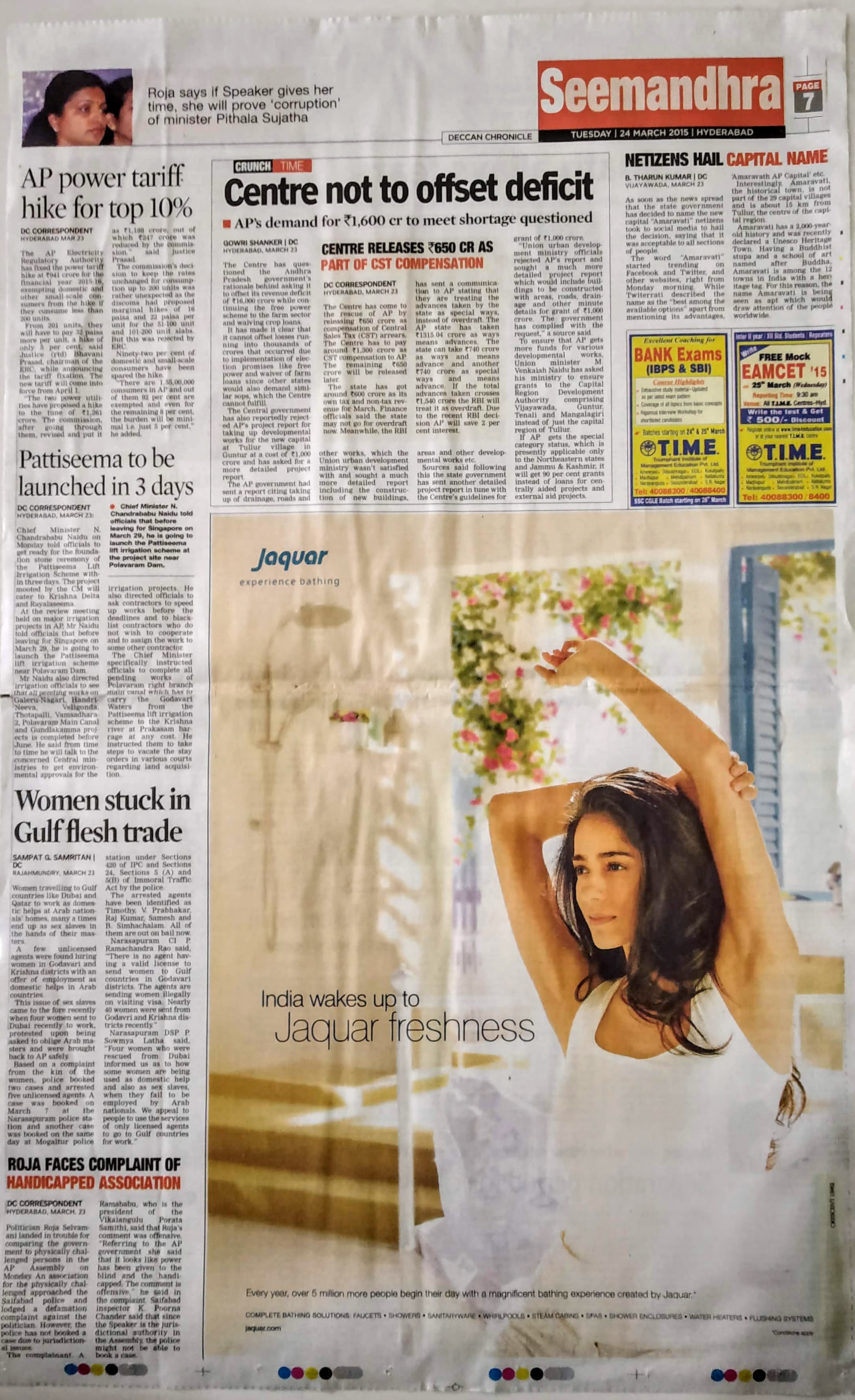
Andhra Pradesh: Centre not to offset deficit
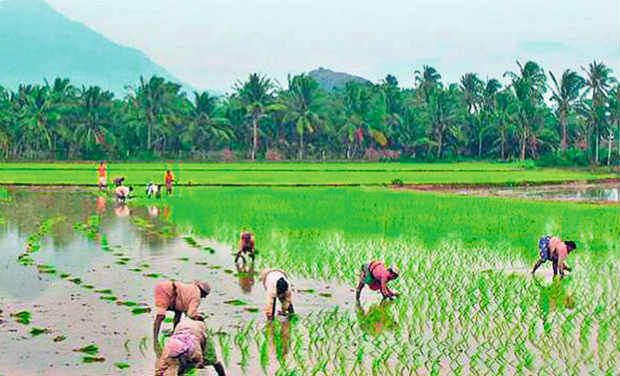
It has made it clear that it cannot offset losses running into thousands of crores that occurred due to implementation of election promises like free power and waiver of farm loans since other states would also demand similar sops, which the Centre cannot fulfill.
The Central government has also reportedly rejected AP’s project report for taking up developmental works for the new capital at Tullur village in Guntur at a cost of `1,000 crore and has asked for a more detailed project report.
The AP government had sent a report citing taking up of drainage, roads and other works, which the Union urban development ministry wasn’t satisfied with and sought a much more detailed report including the construction of new buildings, areas and other developmental works etc.
Sources said following this, the state government has sent another detailed project report in tune with the Centre’s guidelines for grant of `1,000 crore.
“Union urban development ministry officials rejected AP’s report and sought a much more detailed project report which would include buil-dings to be constructed with areas, roads, drain-age and other minute details for grant of `1,000 crore. The government has complied with the request,” a source said.
To ensure that AP gets more funds for various developmental works, Union minister M. Venkaiah Naidu has asked his ministry to ensure grants to the Capital Region Development Authority comprising Vijayawada, Guntur, Tenali and Mangalagiri instead of just the capital region of Tullur.
If AP gets the special category status, which is presently applicable only to the Northeastern states and Jammu & Kashmir, it will get 90 per cent grants instead of loans for centrally aided projects and external aid projects.


K Chandrasekhar Rao sees a wave,
90 seats for TRS in Telangana
'Congress is a gone case. Wait for few more days and you will know it'
Hyderabad: “We will get 2/3rd majority and form the government. There is a clear wave,” said TRS chief K. Chandrasekhar Rao on Wednesday.
Mr Rao flew down to his native Chintamadaka village in Siddipet mandal of Medak district in a helicopter from his farmhouse in Gajwel and exercised his franchise along with his wife Sobha on Wednesday.
Mr Rao is contesting from Medak Lok Sabha and Gajwel Assembly constituencies in Medak district.
Asked whether he was nervous, he said “Chunaav ladte hai lekin darte nahi. Hum sarkar form karne ja rahe hai. 2/3rd majority hume milegi (We fight elections, but are not scared of it. We are going to form the next government. We will get 2/3rd majority.)”
When asked whether he was confident of forming the next government, he remarked, “Hundred per cent. We will form the government on our own.”
Asked if TRS would seek Congress’ support in case of a fractured verdict, he said, “I don’t see a fractured verdict. We will come on our own with close to 90 seats.”
“Congress is a gone case. Wait for few more days and you will know it,” he added when reminded that Congress too was claiming credit for Telangana and was confident of a big win.
Mr Rao, who is currently Mahbubnagar MP, has made it a point to cast his vote in his native village since the past three decades. “It’s thrilling to vote in the new state of Telangana,” he said.
“We have been waiting for him since morning. He makes it a point to vote in the village and interact with locals. The village has 1,552 voters,” said sarpanch Sekhar.
As reports trickled from various parts of Telangana on Wednesday, TRS leaders were in jubilant mood. “People are seeking a change. They want to give a chance to TRS to rule,” said a senior party leader.

Telangana: KCR plans a ‘coup’ on Hyderabad Army areas

Defence land for Telangana Secretariat soon


K Chandrasekhar Rao says no to old Personal Assistants


Aasara turns nightmare


Elections 2014: Telugu Desam Party seals deal with BJP


MIM questions Telangana State land regularisation

Three acre land for poor Dalits

Sources told this newspaper that Chief Minister K Chandrasekhar Rao was keen on according top priority to landless Dalits first, followed by other Dalits under the scheme.
“Our first priority will be landless Dalits followed by other better off Dalits. Most landless Dalits are agricultural labourers, bonded labour and lead an awfully poor life. It is the desire of the CM to help them first. A survey is already on to identify beneficiaries,” a senior official said.
According to government plans, Dalits in rural areas alone would get the land and not in urban and semi-urban areas, where land is costly. The government intends to spend Rs 5 lakh to Rs 15 lakh per beneficiary under the scheme, which is the second major scheme to be floated from August 15 after the announcement of the Rs 1 lakh loan waiver scheme.
While a landless poor Dalit will get three acre of land in one place, other SC beneficiaries having small plots of land of half, one and two acre and others shall be provided with the balance to make them land owners for three acre each, in the following phases.
The scheme, including development of the land, will be applicable to all lands purchased under the scheme in the past and in the future. It will include all lands, which are under the possession and cultivation of the Scheduled Caste beneficiaries, including assigned lands, government land assigned, surplus lands assigned, all lands inherited by the Scheduled Castes beneficiaries among others.
Of the Dalit households accounting for 11.92 lakh in the state, 9.2 lakh reside in rural areas, and the rest in semi-urban and urban areas. Of them, landless Dalit number about three lakh.
Besides registering the land in the name of women of the SC household, the government will bear the entire cost of registration fee, stamp duty and other incidental expenses.
A comprehensive package has also been envisaged for development of the land, including irrigation facilities, drip facilities, seed, cost of cultivation, fertilisers, pesticides, ploughing, micro irrigation, energisation, pump sets among others for one crop year.
This is in addition to providing funds for land development, preparation of nursery and agricultural inputs. The amounts for meeting the cost of cultivation etc shall be directly transferred into the beneficiary’s account.


K Chandrasekhar Rao gets party support for Telangana CM post


Stars favour Narendra Modi, Telengana Rashtriya Samiti


KCR rejects Modi, hints at post poll alliance with Congress


K Chandrasekhar Rao plans to make Singareni Collieries a Telangana company
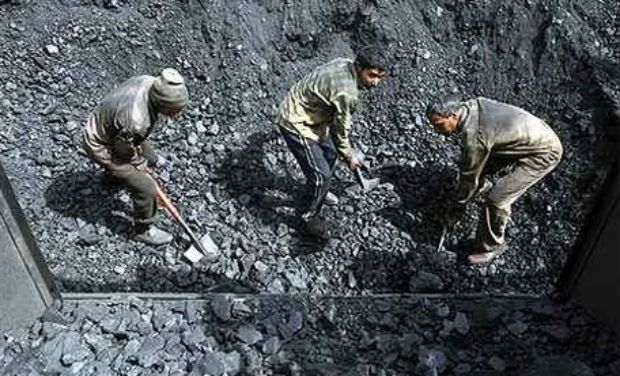

Beacons of consolation


Erragadda land may be converted into parade ground, suggests Telangana CM


MIM bat for Metro in old city west
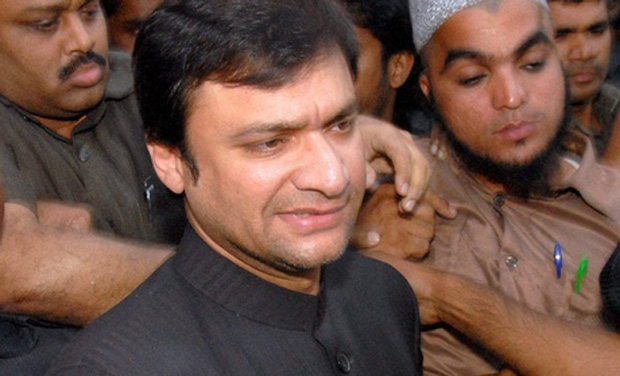


Parties gear up for GHMC polls


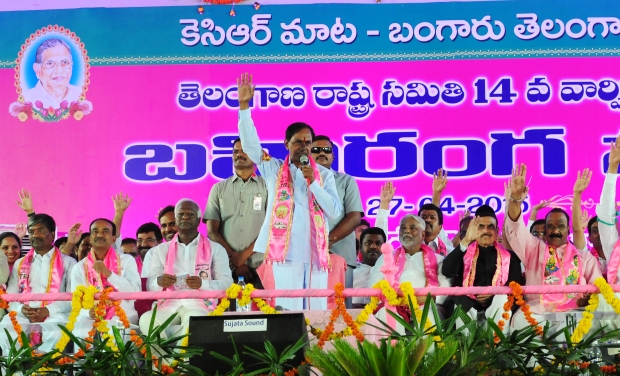
World-class city in three years, vows Telangana CM K Chandrasekhar Rao


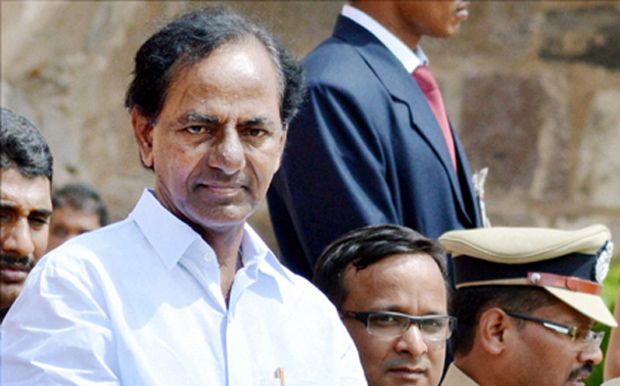
Telangana CM K Chandrashekhar Rao cracks the whip on officials


Political parties on membership overdrive in Telangana


No need for Section 8: Telangana Chief Minister K Chandrasekhar Rao to Governor
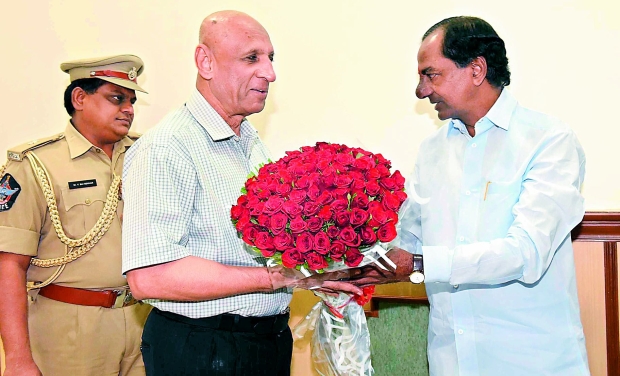


KCR asks Chandrababu Naidu to stop meddling in Telangana




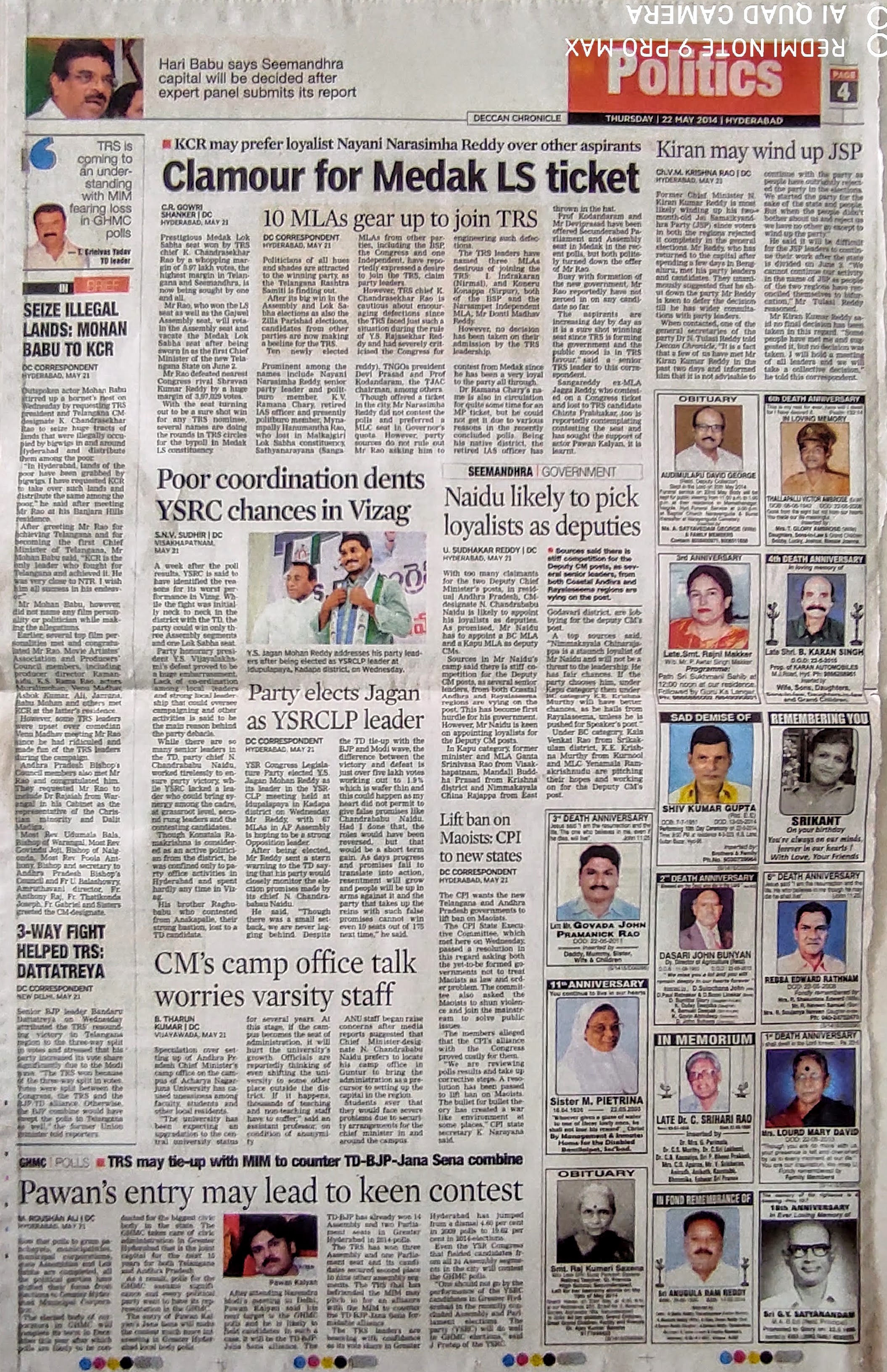


KCR jibe: Andhra dodges tax

2019 Lok Sabha polls: Loyalty change, tickets for kin dominate LS ballgame

K Chandrasekhar Rao's plan to make Congress disappear appears on track

Hyderabad: Chief Minister Mr. K. Chandrasekhar Rao’s ‘Congress Mukt Telangana’ campaign is gradually whittling down the main opposition party. This is partly the TPCC’s own making due to their internal squabbles and sulking leaders, if some Congress leaders are to be believed.K. Chandrasekhar Rao
The TRS and Congress circles indicate that there could be more desertions ahead of the Lok Sabha elections. Eight Congress MLAs have jumped ship, the latest being the Mahesharam MLA Ms. Sabitha Indra Reddy, the L. B. Nagar MLA Mr. D. Sudhir Reddy, and Mr. Vamana Nageswara Rao from Kothagudem.
There are rumours that claim that the Yellareddy MLA Mr Jajula Surender would join the TRS bandwagon, though senior Congress leader Mohd Ali Shabbir denies it.
Earlier in the day, Mr. Sudhir Reddy had told this newspaper that he hadn’t taken any decision on quitting the party.
“Two days ago, somebody called me and wanted to meet me. I told them I am busy. That’s all. Right now I am in Apollo hospital for a checkup with family,” Sudhir Reddy said.
However, Mr. Shabbir Ali said, “It’s a mind game played by Mr. K. Chandrasekhar Rao. They(Mr. Sudhir Reddy and Mr. Surender) are not quitting the party.” Later in the day, Mr. Sudhir Reddy met the TRS Working President Mr. K. T. Rama Rao, and jumped ship.
Every turncoat into the TRS asserts that they were “impressed by Mr K. Chandrasekhar Rao’s development strides and want to develop their own constituencies.”
Chief Minister Mr. K. Chandrasekhar Rao and Mr Rama Rao have formed a potent combination and are sending shivers into the opposition camp.
“It’s Mr. Chandrasekhar Rao’s gameplan to deny the Congress the opposition status in the Assembly. The rule states that 12 MLAs are required to obtain the opposition status. He is successful thanks partly to our own shortcomings,” a senior Congress leader said.
Congress has lost the opposition status in the Legislative Council after defections to the TRS.
Party sources claim that Ms Sabitha Indra Reddy, Mr Sudhir Reddy, and several other leaders, especially those from the Reddy community, are upset with the party leadership.
Some claim that the spirit of Mr. Y S. Rajasekhar Reddy is back and is playing his old games, and this time, he is helping the TRS.
“Danam Nagender would have stayed back if he was made the TPCC Working President. Sabita is upset over the denial of funds, over the denial of ticket to her son, and over being ignored after the entry of the Chevella MP Mr Konda Vishweshwara Reddy. Sudhir Reddy did not get any credit for organising Rahul Gandhi’s public meeting, Mohd Azharuddin had to seek Priyanka Gandhi’s help to get Rahul Gandhi’s appointment. The list is long,” said another senior leader.
The appointment of weak AICC secretaries caused another problem. “Is it a national party or galli party? Somebody is misleading the AICC President Rahul Gandhi a great deal,” he added

Friday, May 27, 2022 | Last Update : 01:56 PM IST
Pasupuleti Balaraju turns a hero for Telangana men
1969 Telangana movement
The Telangana Movement of 1969 was a reaction to the dominance of Andhra leaders
and economic exploitation in Telangana following the formation of Andhra Pradesh in 1956.
with Andhra.
agreements fueled discontent, leading to a strong demand for a separate Telangana state.
Failure of Gentlemen’s Agreement
The Gentlemen’s Agreement of 1956 was meant to provide safeguards for Telangana’s economic and political interests, including job security, educational opportunities, and a separate regional committee.
Committees on Telangana Surplus Grants
The Brahmananda Reddy Government appointed Kumar Lalit, a CAG official, in January 1969 to investigate the surplus funds issue.
However, only ₹34.10 crores was spent on Telangana, leading to demands for the proper utilization of Telangana’s revenue.
Further investigations were conducted by the Bhargava Committee (April 22, 1969), which reported that ₹28.34 crores of Telangana’s revenue was not spent on the region.
The Wanchoo Committee (1969) was appointed to examine the implementation of Mulki rules and recommended constitutional amendments. However, the committee concluded that no power could enforce separate rules for different regions, and the Mulki regulations were not being implemented properly. This further fueled the discontent among Telangana people.
Dissatisfaction Among Telangana Employees
During the Indo-Pak War, budgetary constraints led to job cuts across government departments, disproportionately affecting Telangana employees. Unemployment among Telangana engineers and youth increased, while new recruitments favored candidates from Andhra region, violating
Mulki rules.
By 1967, over 4,000 Andhra teachers had been appointed in Telangana schools, despite qualified local candidates being available. The systematic exclusion of Telangana employees from government jobs led to massive dissatisfaction and increased support for the Telangana Movement.
Large-Scale Migration of Andhra People
Post-merger, large numbers of Andhra people migrated to Telangana and acquired vast tracts of agricultural land, particularly in Nizamabad, Warangal, Khammam, and Adilabad. 60–80% of the fertile lands in the Godavari basin were taken over by Andhra landlords.
Andhra migrants even established colonies with Andhra names, such as Gunturpalle, Bandarpalle, Andhra Colony, Ashok Nagar, and Shanti Nagar, reinforcing the perception that Telangana was being colonized.
Discrimination Against Telangana Ministers
Telangana ministers were routinely sidelined in governance. Important portfolios such as
Home, Finance, and Revenue were given to Andhra leaders, while Telangana ministers were
assigned less significant roles.
Former Hyderabad State Chief Minister Burgula Ramakrishna Rao was denied state honors at his funeral, in contrast to former Andhra Chief Minister Prakasam Pantulu, who received full state honors.
This blatant discrimination deepened the anger and resentment among Telangana political
leaders and the public.
Discrimination in Employment at Thermal Power Station
Godavari water, yet most of its staff were recruited from Andhra. In response, a hunger strike was launched on July 10, 1969, led by Sri Ramdas from Illendu and Ravindranath, a student from Palvancha.
The protest gained momentum, with students and unemployed youth forming the Telangana
Rakshana Samithi to demand job reservations for Telangana locals.
Protesters marched across Khammam, chanting slogans such as “Non-Mulki Go Back”
and “Idli Sambar Go Back”, reflecting their anger against Andhra officials dominating
Telangana’s resources.
Key Political Leaders of the 1969 Telangana Movement
The 1969 Telangana Movement was shaped by dynamic political leaders, student activists,
intellectuals, and civil society members who played a crucial role in mobilizing public support and articulating the demand for a separate Telangana state. Their leadership galvanized protests, influenced public opinion, and pressured the government to address the grievances of Telangana’s people.

Dr. Marri Chenna Reddy
Dr. Marri Chenna Reddy was the most prominent leader of the movement.
He played a decisive role in the formation of the Telangana Praja Samithi (TPS), which
spearheaded the agitation. He actively organized protests, mobilized public support, and
raised awareness about the injustices faced by Telangana. His leadership unified various
factions and strengthened the movement’s demands for a separate state.

Konda Laxman Bapuji
A veteran Telangana activist, Konda Laxman Bapuji was among the first to resign from his
ministerial position in protest against the injustice and discrimination faced by Telangana in the united Andhra Pradesh. His resignation brought national attention to the movement, earning him the title of the ‘Father of Telangana’. His unwavering commitment to the cause inspired many activists to join the struggle.
Makhdoom Mohiuddin
A renowned poet and Communist Party of India (CPI) leader, Makhdoom Mohiuddin used his literary and political influence to articulate the socio-economic injustices faced by Telangana’s people. His poetry and speeches mobilized the masses and intellectuals, giving a cultural dimension to the movement.
Acharya Konda Lakshman Bapuji
A close associate of Dr. Marri Chenna Reddy, he resigned from his cabinet position to
protest the continued marginalization of Telangana. His activism further strengthened the
moral and political legitimacy of the movement and put pressure on the government to addressTelangana’s concerns.
Student leaders and their role
M. V. Ranga Reddy
One of the most influential student leaders, Ranga Reddy played a critical role in organizing
protests, rallies, and demonstrations, particularly in Osmania University. His leadership was
instrumental in channeling student activism into a coordinated mass movement, ensuring that the demands of the students and youth were heard.
Mallikarjun
A student leader who coordinated protests, strikes, and sit-ins, Mallikarjun was a key figure in maintaining the momentum of student activism. His efforts helped amplify the voices of
Telangana youth, making student participation a powerful force in the movement.
Civil Society and Intellectuals
B. J. Ranga Reddy
An influential intellectual and social activist, B. J. Ranga Reddy played a vital role in shaping public discourse around the Telangana issue. Through writings, public discussions, and advocacy, he brought the movement’s grievances to a broader audience.
P. V. Narasimha Rao
Though he later became the Prime Minister of India, during the 1969 Telangana Movement,
P. V. Narasimha Rao played a mediatory role. His deep understanding of Telangana’s historical and economic issues allowed him to act as a bridge between the movement and the central government.
Women Activists and Their Contribution
Mandalapu Ramadevi
A prominent women’s rights activist, Mandalapu Ramadevi was instrumental in mobilizing
women’s participation in the movement. She ensured that the voices of Telangana’s women
were heard and contributed significantly to strengthening the mass movement.
Key Events and Their Leaders
Formation of Telangana Praja Samithi (TPS)
Leaders Involved: Dr. Marri Chenna Reddy, Konda Laxman Bapuji
Significance: The TPS became the main political platform for Telangana agitation.
It organized protests, rallies, and negotiations, making the demand for a separate state a
formal political agenda.
Student Protests
Leaders Involved: M. V. Ranga Reddy, Mallikarjun
Significance: Students played a crucial role in intensifying the movement.
Osmania University and other educational institutions became epicenters of protests, forcing the government to take the Telangana issue seriously.
Mass Rallies and Strikes
Leaders Involved: Dr. Marri Chenna Reddy, Konda Laxman Bapuji, student leaders
Significance: Widespread strikes and rallies demonstrated the deep-rooted support for
Telangana’s statehood. These protests created political pressure on the Andhra Pradesh
government and the central leadership.
Resignation of MLAs
Leaders Involved: Konda Laxman Bapuji and other Telangana legislators
Significance: Several Telangana MLAs resigned in protest, showing the intensity of regional discontent and proving that the movement had significant political backing.
The 1969 Telangana Movement showcased not just political agitation but a broad-based leadership effort that significantly steered the movement’s direction. These leaders’dedication set the stage for future campaigns, ultimately leading to the establishment ofTelangana state in 2014.
From 1952 to 2014, numerous individuals sacrificed their lives in the pursuit of establishing Telangana State.
Specifically, during the 1969 Telangana movement, approximately 369 students and other individuals died many in police firing. In later stages of the movement, a significant number of students, youth, and others in Telangana also committed suicide in support of the state’s formation.
The book “Telangana Movement Suicides, Sacrifices, Martyrs” documents that 885 people died due to related actions from November 29, 2009, to December 9, 2012. KCR however claimed 1100 deaths but paid Rs 10 lakh each to kin of the dead to only about 500 odd victims
Following the attempted suicide of Srikantha Chary on November 29, 2009, which led to his death on December 3, 2009, there were nine additional deaths reported. This includes suicides by Srikanth from Medak district and Bhukya Praveen from Warangal district on November 30, 2009.
Subsequent suicides include constable Kistaiah from Nizamabad district and Ashok from Karimnagar district, both of whom died on December 1, 2009.
Kasoju Srikantha Chary:
He belongs to Podichedu Village, Mothkur Mandal of Yadadri district. His parents were Shankaramma, Venkata Chary.
In the later phase of Telangana movement, Srikantha Chary was the first student to sacrifice his life.
On 29th November, 2009 he committed suicide by pouring Kerosene on his body in front of Ambedkar Statue at L.B. Nagar X roads, Hyderabad. He died on 3rd December, 2009.
Constable Kistaiah:
On 1st December, 2009, constable Kistaiah of Nizamabad committed suicide by shooting himself with his service gun seeking separate Telangana State.
Kistaiah was a constable of the 1992 batch. He is a native of Shivayi palli village, Biknur Mandal of Nizamabad district.
Venu Gopal Reddy:
On 19th January, 2010, Venu Gopal Reddy of Nalgonda committed suicide in Osmania University.
Siripuram Yadaiah:
On 20th February, 2010, Siripuram Yadaiah set himself on fire by pouring Kerosene near NCC gate, Osmania University.
Ishan Reddy:
Ishan Reddy of Medak district wished before Maisamma (deity) that he will sacrifice hislifeif D.SrinivasofNizamabaddistrictis defeated in the by – elections.
On 31st July, 2010, Ishan Reddy committed suicide as D. Srinivas was defeated in the by- elections.
Chiraboina Kanakaiah:
Physically handicapped Chiraboina Kanakaiah of Warangal district committed suicide for theformationofseparateTelanganaState,died on 15th February, 2011.
Yadi Reddy:
Yadi Reddy of Moinabad committed suicide on 20th July, 2011 in front of Shastri Bhavan near Parliament, Delhi.
Bhojya Nayak:
On 24th March, 2012, Lunawat Bhojya Nayak of Warangal district died by pouring petrol & setting himself on fire near Public Gardens, Hanumakonda by making slogans “ I want Telangana and Jai Telangana”.
Siripuram Srikanth:
On 28th March, 2012, BJP activist Siripuram Srikanth committed suicide by setting himself on fire at Hyderabad.
Gudi Raji Reddy:
Gudi Raji Reddy of Karimnagar district migrated to Hyderabad for livelihood.
On 30th September, 2012 Raji Reddy participated in the “Sagaraharam” program organized by JAC. On the same day, police opened fire on them, due to which Raji Reddy suffered from a serious illness and died on 25th October, 2012 while undergoing treatment.
Avinash:
Avinash committed suicide by giving a testimony to T-News channel that he is sacrificing his life to fill inspiration among lakhs of Telangana supporters to achieve Telangana, and in that Telangana his brothers can come out of Slavery & live freely.
Devender Reddy (2010):
Devender Reddy was the first lawyer to commit suicide for the State of Telangana.
Not only these, but many more people sacrificed their lives for Telangana.


1969 Telangana memorial at Clock Tower Secunderabad
The 1969 Telangana Memorial, known as the Telangana
Martyrs Memorial or Gun Park Stupam, honors the 369 students and
agitators killed fighting for a separate state. While located at the Public
Gardens in Hyderabad, the nearby Secunderabad Clock Tower also houses a
memorial garden where veterans commemorate the 1969 movement.
Key Memorial Sites in Hyderabad
Telangana Martyrs Memorial (Gun Park): The official, historic monument near
the Public Gardens honoring the 1969 movement.
Secunderabad Clock Tower Garden: Located on S.D. Road, this
colonial-era landmark features a memorial garden where movement veterans gather
every April 4th to pay tribute to the 1969 martyrs.
Telangana Amara Jyothi: The soaring, flame-shaped stainless steel monument
built on the banks of Hussain Sagar.
Visiting & Commemoration Details
Dates of Note: "Telangana Martyrs Day" is observed every year on June 2nd across all districts of the state.
On April 4th, veterans hold a
special prayer gathering at the Secunderabad Clock Tower to mark the
anniversary of the 1969 police firing.
The history of Telangana state is
long and rich, shaped by geography, rivers, kingdoms, and people’s movements.
Telangana has seen ancient settlements, powerful dynasties like the Kakatiyas, Islamic sultanates, Nizam rule, British influence, and finally a long struggle that led to the formation of Telangana as a separate state in 2014.
Timeline of Telangana History:
c. 100,000 BCE – Early human settlements in the Deccan region
1st century BCE – Satavahana rule begins
12th century CE – Rise of the Kakatiya dynasty
1323 – Fall of Warangal and end of Kakatiya rule
1518 – Qutb Shahi dynasty comes to power
1591 – Hyderabad city founded
1724 – Beginning of Nizam rule
1948 – Hyderabad State merged into India
1956 – Telangana merged with Andhra Pradesh
2 June 2014 – Telangana becomes a separate state

Ancient History of
Telangana
Prehistoric Telangana
Archaeological evidence shows that Telangana was inhabited by humans from very
early times. Stone tools, cave shelters, burial sites, and pottery fragments
have been discovered in districts such as Adilabad, Karimnagar, Warangal, and
Nalgonda.
History
The region lies on the Deccan plateau, which has fewer natural rivers compared
to coastal regions. Because of this, early communities learned to depend on
seasonal rainfall and developed methods to store water. This early focus on
water storage later became a defining feature of Telangana’s civilization.
Satavahana Dynasty in Telangana (1st Century BCE – 3rd Century CE)
The Satavahana
dynasty was one of the earliest major ruling powers in Telangana and
the Deccan. Their rule lasted for nearly four centuries.
The Satavahanas:
Encouraged trade inside and outside India
Used coins made of silver and copper
Supported Buddhism and Hinduism
Improved farming and irrigation
Important Buddhist centers such as Phanigiri and Nelakondapalli developed
during this time. Telangana became part of major trade routes linking northern
India with southern ports.
Early Medieval History of Telangana
After the decline of the Satavahanas, Telangana came under the rule of several
dynasties, including:
Vakatakas
Ikshvakus
Vishnukundins
Chalukyas
Rashtrakutas
These rulers strengthened local administration and promoted temple building.
The Vishnukundins were among the first dynasties closely associated with the
Telangana region itself. They built early temples and forts and supported both
Shaivism and Vaishnavism.
Although political power changed hands often, village-based agriculture
remained central. Irrigation tanks and community farming systems expanded
steadily during this period.
Kakatiya Dynasty in Telangana (12th–14th Century)
The Kakatiya
dynasty represents the most important and influential period in
Telangana history. Their rule is often described as the golden age of
Telangana.
Warangal as the Capital
The Kakatiyas ruled mainly from Warangal, which became a major administrative,
military, and cultural center. Warangal connected interior Telangana to trade
routes across the Deccan.
Important Kakatiya Rulers
Ganapati Deva
Rudrama Devi
Prataparudra II
Rudrama Devi
Rudrama
Devi was one of the very few women rulers in Indian history. She ruled
with courage and skill, defended the kingdom from invasions, and maintained
stability during a difficult period.
Kakatiya Irrigation System (Why It Mattered)
Because Telangana lacked large river deltas, the Kakatiyas developed a tank-based
irrigation system. Thousands of interconnected tanks were built to collect
and store rainwater.
This system:
History
Supported agriculture in dry regions
Reduced dependence on rivers
Strengthened village economies
Increased food production
Many of these tanks continued to serve villages for centuries and are still in
use today.
Architecture and Culture Under the Kakatiyas
Major monuments include:
Warangal Fort
Thousand
Pillar Temple
Ramappa (Rudreshwara) Temple
The Ramappa
Temple, built in the 13th century, shows advanced engineering and
artistic skill. It later became a UNESCO World Heritage Site.
The Kakatiyas also encouraged Telugu language, literature, and local
traditions, strengthening regional identity.
Fall of the Kakatiyas (1323)
In 1323, Warangal was attacked by the Delhi Sultanate. The defeat of
Prataparudra II marked the end of Kakatiya rule and a major turning point in
Telangana history.
Sultanates and Golconda Kingdom History In Telangana
After the Kakatiyas, Telangana came under the Bahmani Sultanate. Later, the
Qutb Shahi dynasty emerged as an independent power.
Qutb Shahi Dynasty (1518–1687)
The Qutb Shahi dynasty ruled Telangana from Golconda
Fort.
Key contributions:
Foundation of Hyderabad city in 1591
Construction of Charminar
Promotion of Telugu, Persian, and Urdu
Growth of diamond trade from Golconda
Golconda became famous across the world for its diamonds.
Mughal Rule and the Rise of the Nizams
In 1687, Mughal emperor Aurangzeb conquered Golconda. After Mughal power
weakened, Asaf Jah I declared independence in 1724, starting the Nizam dynasty.
Hyderabad State and Nizam Rule (1724–1948)
Beginning of Nizam Rule
In 1724, Asaf Jah I, also called Nizam-ul-Mulk, founded the Nizam dynasty. The
Nizams ruled Hyderabad State for more than 200 years.
Historical Sites & Buildings
Hyderabad State was one of the largest princely states in India.
Rural Telangana Under the Nizams
While the city developed, rural Telangana suffered from:
Feudal landlord control
Heavy taxation on farmers
Forced labor practices
This uneven development created deep dissatisfaction among villagers and
farmers.
British Influence in Telangana
Although Hyderabad was not directly ruled by the British, it was under British
influence through treaties. The British controlled external affairs, while the
Nizam ruled internally.
Modern education and administration developed, but social inequality remained
high.
Telangana Rebellion and Integration with India
Telangana Rebellion (1946–1951)
The Telangana Rebellion was a peasant movement against feudal landlords
during the last years of Nizam rule. Farmers demanded land rights and freedom
from oppression.
Operation Polo (1948)
After India’s independence in 1947, the Nizam refused to join India. In
September 1948, the Indian government carried out Operation Polo.
As a result:
Hyderabad State merged with India
Nizam rule ended
Democratic governance began
Formation of Andhra Pradesh (1956)
In 1956, Telangana was merged with Andhra State to form Andhra Pradesh, based
on language.
However, many people in Telangana felt:
Promises made during the
merger were not fully followed
Water, jobs, and funds were unevenly shared
This led to growing dissatisfaction.
Telangana Movement History (1969–2014)
1969 Telangana Agitation
The first major movement for a separate Telangana state began in 1969. Though
it did not succeed, it kept the demand alive.
Renewed Movement (2001–2014)
The movement gained strength again after 2001, led by political parties,
students, and civil groups.
Major events included:
Public protests
Hunger strikes
Nationwide political debates
Formation of Telangana State (2014)
The Indian Parliament passed the Andhra Pradesh Reorganisation Act, 2014.
2 June 2014 – Telangana became the 29th state of India
Hyderabad became the capital
K. Chandrashekar Rao became the first Chief Minister
This marked the end of a long struggle and the beginning of a new chapter.
Telangana After 2014
Since its formation, Telangana has focused on:
Irrigation and farming support
Welfare schemes
Industrial and IT growth
Urban development
Hyderabad has grown as a major technology and business hub.
Culture and Language of Telangana
Telugu is the main language, with a unique Telangana style
Festivals like Bathukamma and
Bonalu are widely celebrated
Folk arts, music, and
traditions remain strong
Telangana culture reflects both ancient roots and modern life.
Conclusion
The history of Telangana is a story of resilience, culture, and identity. From
ancient settlements to powerful kingdoms, from colonial influence to people’s
movements, Telangana has shaped its own path.
Understanding Telangana’s history helps us understand its present and future.
Frequently Asked Questions
When was Telangana formed as a state?
Telangana was formed on 2 June 2014. For more facts visit – facts
about Telangana State
Who ruled Telangana before independence?
The Nizams of Hyderabad ruled Telangana before independence.
History
Why was Telangana separated from Andhra Pradesh?
Due to long-standing issues related to water, jobs, and regional development.
Why is Hyderabad important in Telangana history?
It was the capital of the Qutb Shahis, the Nizam state, and is now Telangana’s
capital.

A meeting of Journalists who participated in the separate Telangana movement led by former Chief Minister and TRS turned BRS supremo K Chandrasekhar Rao was held at Telangana Contractors Club, Kondapur, Serilingampally Ranga Reddy district on July 20, 2026 at 4 pm.
Sri Allam Narayana, TUJ chief and ex Editor Namasthe Telangana, Andole Ex MLA Sri Kranthi Kiran, Ambedkar Open University Vice Chancellor Sri Ghanta Chakrapani, Ex Andhra Jyothi Editor Sri K Srinivas, Sri C R Gowri Shanker, ex Political Editor, Deccan Chronicle, Sri P V Srinivas, Information Commissioner, Sri Sailesh Reddy, Namasthe Telangana and others participated.


KMKG Gold Traders has exceeded my expectations! Their experienced personnel and fair prices make them my preferred gold buyer in Gachibowli.for more Visit us!
ReplyDeleteGold Buyers in Gachibowli